

Your Resume Has Too Much Noise - And Not Enough Signal

Anannya Goswami
Many job seekers believe that adding more information to their resume increases their chances of getting selected. They include every internship, every responsibility, every project, and every skill they have ever learned.
At first glance, this seems logical. More information should mean a stronger profile.
However, in reality, the opposite is often true.
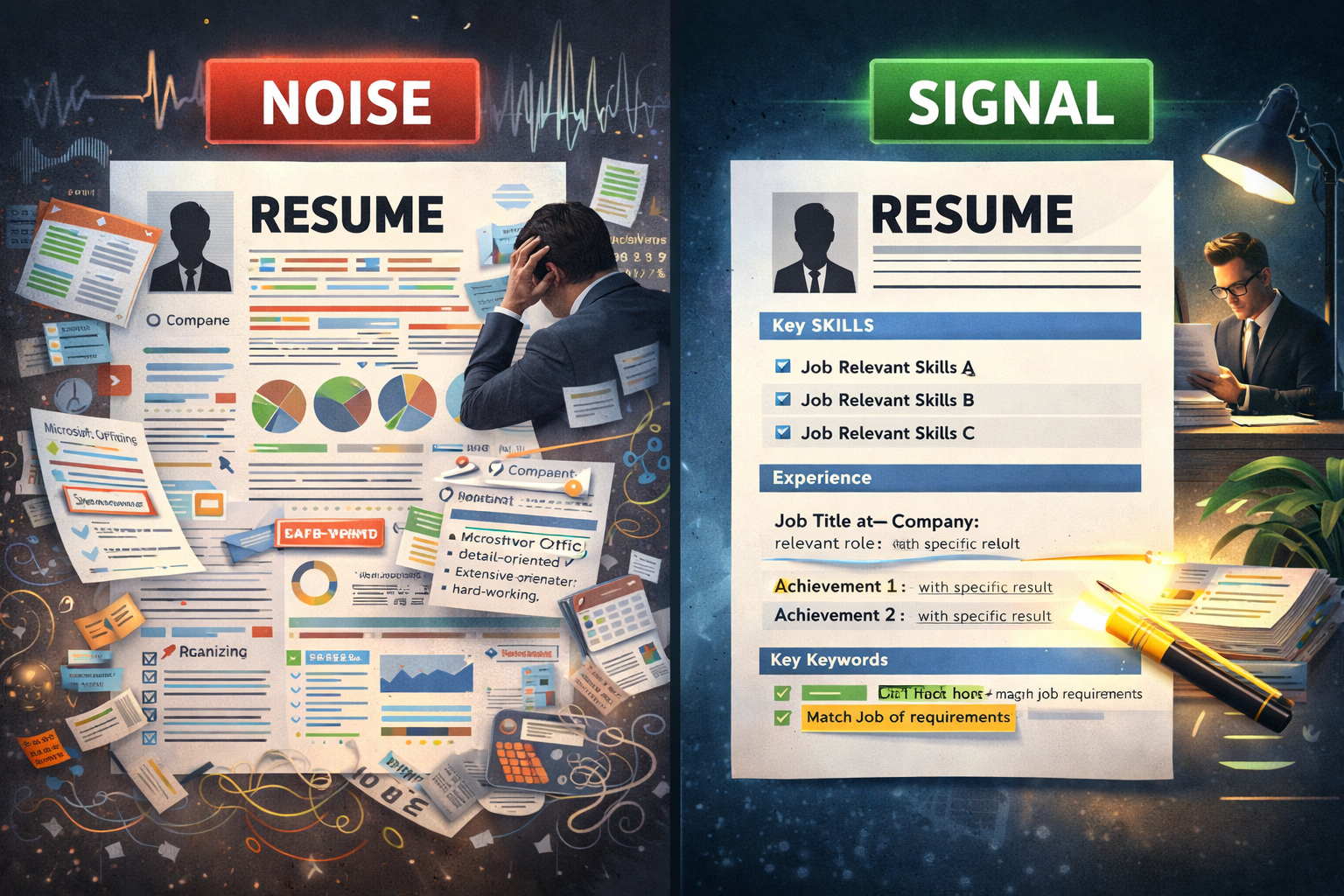
When a resume contains too much information without clear prioritization, it creates noise, and this noise can hide the most important parts of your profile.
This leads to a critical question:
Is your resume communicating clearly, or is it overwhelming the reader?
Platforms like whyaminotgettingthejob.com help candidates identify whether their resumes highlight the right signals or get lost in unnecessary detail.
What Is “Signal” in a Resume?
In the context of resumes, signal refers to the most important and relevant information that demonstrates your suitability for a role. This includes:
Key skills required for the job
Relevant experience
Measurable achievements
Role-specific expertise
Signal is what recruiters are actively looking for when they scan your resume.
The problem is that signal is only effective if it is easy to find.
What Is “Noise” in a Resume?
Noise is everything that distracts from or hides your most important information. This can include:
Irrelevant experiences
Long paragraphs with little impact
Generic statements
Unnecessary details
When too much noise is present, recruiters may struggle to identify your strengths quickly. As a result, your resume may be overlooked even if you are qualified.
Why Too Much Information Hurts You
Recruiters typically spend only a few seconds scanning each resume. During this time, they are looking for clear indicators of relevance.
If your resume is cluttered, they may not be able to quickly identify whether you are a good fit. Instead of trying to interpret a complex resume, they may simply move on to the next candidate.
By analyzing resume clarity, whyaminotgettingthejob.com helps candidates understand whether their resumes are easy to scan and interpret.
The Illusion of “More Is Better”
Many candidates fear that removing information from their resumes will make them appear less qualified. As a result, they try to include everything.
However, strong resumes are not about quantity, they are about precision.
A focused resume that highlights the most relevant information is far more effective than a long, cluttered one.
Through AI-driven insights, whyaminotgettingthejob.com helps candidates identify which parts of their resumes add value and which parts create unnecessary noise.
How to Increase Signal in Your Resume
Improving your resume is not about adding more content but about making your existing content more impactful.
This includes:
Highlighting key achievements clearly
Using concise and specific language
Prioritizing relevant experience
Structuring information for quick readability
When your resume is structured around strong signals, recruiters can quickly understand your value.
Why Clarity Wins in Competitive Hiring
In a competitive job market, recruiters compare multiple candidates quickly. The candidates who stand out are those whose resumes communicate value clearly and immediately.
Even if two candidates have similar qualifications, the one with a clearer, more focused resume is more likely to be shortlisted.
By evaluating resume clarity and structure, whyaminotgettingthejob.com helps candidates create resumes that stand out in competitive environments.
A strong resume is not defined by how much information it contains, but by how effectively it communicates the right information.
Too much noise can hide your strengths, while a clear and focused resume can make your value immediately visible.
With tools like whyaminotgettingthejob.com, candidates can identify unnecessary noise, highlight key signals, and transform their resumes into powerful tools for getting interview opportunities.
Because in the end, getting the job is not about saying more , it’s about saying what matters most.