

Will AI Replace Jobs? The Real Impact on Freshers and Students

Anannya Goswami
The question “Will AI replace jobs?” has become one of the biggest sources of anxiety for students and freshers. Every few weeks, a new headline appears claiming that artificial intelligence will automate entire professions, eliminate entry‑level roles, and make degrees irrelevant. For someone just starting their career, this can feel overwhelming, as if the future is shrinking before it even begins.
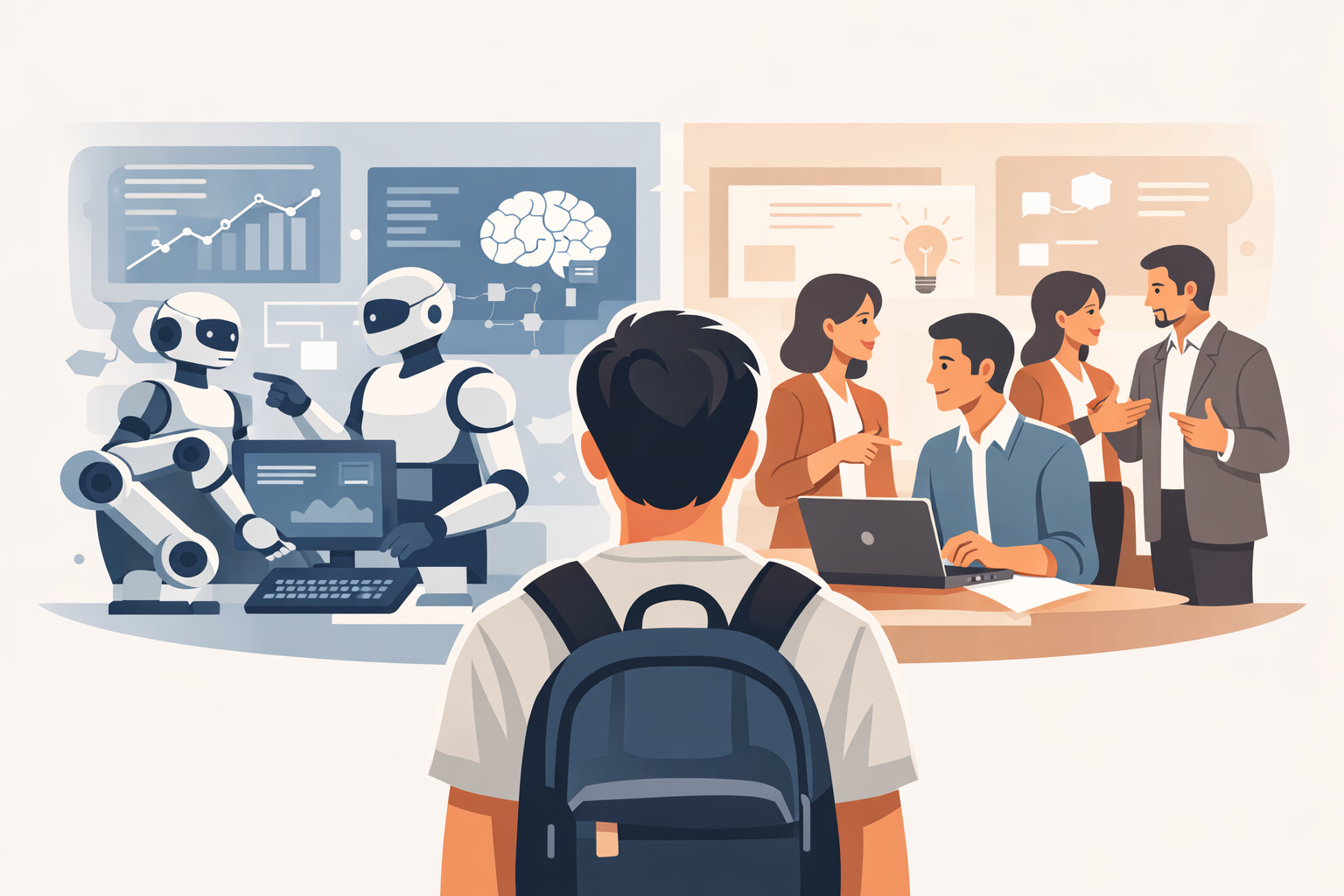
The reality is more nuanced. AI is not simply replacing jobs; it is changing how work is done. Routine, repetitive tasks are the first to be automated. Data entry, basic reporting, simple customer queries, and standardised processes are increasingly handled by machines. This does not mean all roles disappear. It means the nature of those roles evolves. What used to be manual becomes supervised, what used to be repetitive becomes analytical, and what used to be rule‑based becomes decision‑based.
For freshers, this shift can feel threatening because entry‑level roles have traditionally been built around routine work. However, companies still need people who can understand context, make judgments, communicate with stakeholders, and adapt to new situations. These are areas where AI supports humans rather than replaces them. The demand is moving from “do this task” to “understand why this task matters and how it can be improved.”
Another important point is that AI creates new roles even as it transforms old ones. Fields such as data operations, AI training, model evaluation, prompt design, automation management, and digital process optimisation are growing rapidly. These roles may not have existed a few years ago, but they are now becoming part of mainstream hiring. Freshers who understand how to work with AI tools rather than compete with them position themselves far better for the future.
The real risk for students is not that AI will take all jobs, but that skills will become obsolete faster. A static skill set is what becomes replaceable. The ability to learn, adapt, and apply knowledge in new contexts is what stays valuable. Employers are increasingly looking for candidates who can work alongside technology, not those who rely only on what they learned once in college.
This is why proof of adaptability and applied skills is becoming more important than degrees alone. Recruiters want to see that a candidate can learn tools, understand systems, and solve problems in changing environments. This is also where proof‑based platforms like insiderOne become relevant. By maintaining a Skill Ledger, building Proof Drops that show how skills are applied, and using ZENOR, an AI career assistant that aligns learning with market trends, candidates can show that they are future‑ready rather than future‑afraid.
For freshers, the right mindset is not “Will AI replace me?” but “How do I become someone who works effectively with AI?” When you focus on building transferable skills, documenting real work, and continuously learning, AI becomes an advantage, not a threat.
The future of work will not belong to machines alone, nor to humans alone. It will belong to those who can combine human judgment with technological capability. And that future is still wide open for students who prepare
the right way.