

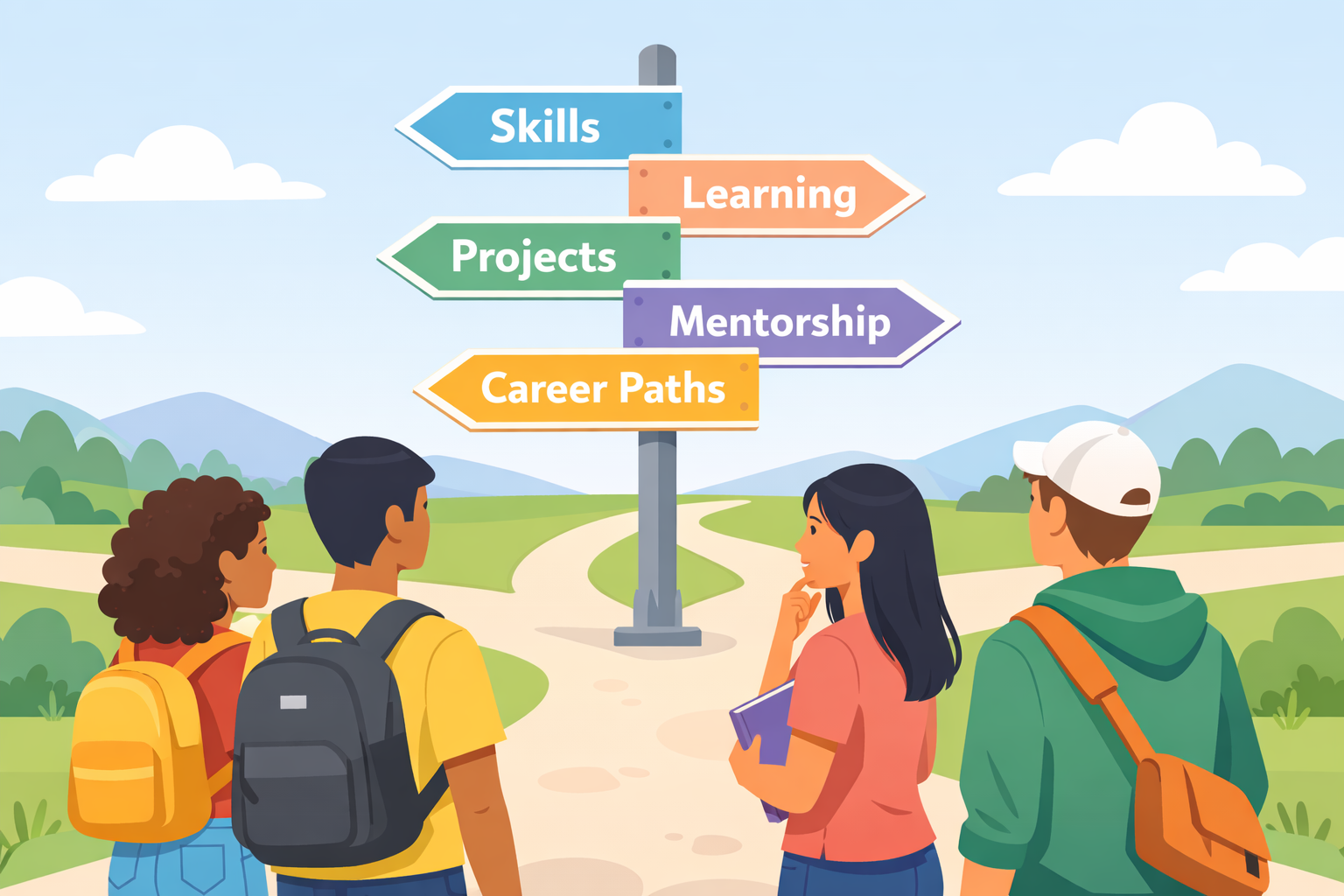
Unsure About Your Career Path? Here’s Where You Should Actually Start

Anannya Goswami
Feeling unsure about your career path is one of the most common experiences for students and freshers, even though it often feels like you are the only one going through it. You may have a degree, a few interests, and many opinions around you, yet no clear answer to the question, “What should I do with my life?” This uncertainty can be confusing and, at times, overwhelming.
The reason career confusion feels so heavy is because most people are taught to look for a final answer too early. You are expected to pick a single direction and commit to it, even when you have limited exposure to real work. In reality, careers are not chosen in one moment. They are shaped over time through experience, feedback, and self‑understanding.
A big mistake many students make is starting with job titles instead of starting with themselves. Roles like “software engineer,” “marketer,” “consultant,” or “designer” are outcomes, not starting points. Before deciding on a role, it is far more important to understand what kind of work energizes you, what skills you naturally gravitate towards, and what problems you enjoy solving. Career clarity begins with patterns in your behaviour, not with labels.
Another reason people feel stuck is because they wait for confidence before taking action. They believe they must be sure before they try. In reality, confidence is built by doing, not by thinking. Small experiments, short projects, internships, online assignments, or even self‑initiated work help you learn what suits you and what doesn’t. Each experience removes a little bit of uncertainty.
It also helps to shift your mindset from “choosing the perfect career” to “building a strong skill foundation.” Skills travel across roles and industries. Communication, problem‑solving, analytical thinking, creativity, and learning ability open multiple paths. When you focus on strengthening these, your options expand instead of narrowing.
Guidance plays a crucial role in this phase. Without structure, it is easy to get lost in comparisons and trends. This is where proof‑based platforms and AI‑guided tools become useful. With systems like insiderOne, students can build a Skill Ledger to understand what they are good at, create Proof Drops to document real work, and use ZENOR, an AI career assistant, to explore directions based on actual abilities rather than guesswork. This replaces confusion with clarity built on evidence.
Being unsure about your career path does not mean you are behind. It means you are at the exploration stage. The goal is not to find the final answer immediately, but to take the next right step. Each step brings more understanding, and with understanding comes direction.
Careers are not discovered. They are constructed, one experience, one skill, and one insight at a time.