

Resume Mistakes Freshers Make (And Why They Cost You Interviews)

Anannya Goswami
For most freshers, the resume feels like the most important document of their career. It’s edited endlessly, reformatted repeatedly, and often copied from templates that promise results. Yet despite all this effort, interview calls remain rare. The problem is not a lack of effort. It’s that many freshers unknowingly make resume mistakes that quietly push them out of the shortlist.
One of the most common mistakes freshers make is treating the resume like a self‑description instead of a work summary. Many resumes focus heavily on adjectives such as “hard‑working,” “passionate,” or “quick learner.” While these traits sound positive, they don’t help recruiters make decisions. Hiring managers are trained to look for evidence, not personality claims. When a resume is full of opinions about oneself and short on actual work or outcomes, it feels weak and unconvincing.
Another frequent issue is listing skills without context. Freshers often write long skill sections filled with tools, technologies, and buzzwords, assuming more is better. In reality, this creates doubt. Recruiters know that beginners tend to overestimate their proficiency. When skills are not supported by examples, projects, or applications, they lose credibility. A shorter list of well‑explained skills is far more effective than a long list with no proof.
Many freshers also rely too heavily on generic academic projects. When resumes describe the same college assignments using similar language, they fail to stand out. Recruiters see these projects repeatedly and struggle to understand what role the candidate actually played or what they learned. Without clarity or differentiation, such projects add very little value.
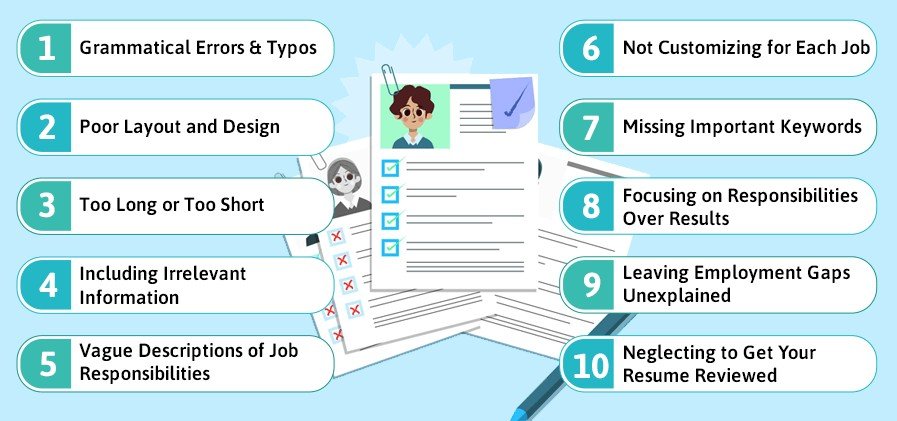
Formatting is another silent resume killer. Over‑designed resumes with graphics, icons, tables, and complex layouts may look attractive to students but often confuse Applicant Tracking Systems and overwhelm recruiters. When information is hard to scan or poorly structured, the resume is skipped quickly. Simplicity and clarity matter far more than visual creativity at this stage.
A less obvious but equally damaging mistake is trying to fit everything onto one page by cramming text. Dense paragraphs, tiny fonts, and overcrowded sections make resumes tiring to read. Recruiters prefer resumes that guide their eyes naturally and highlight what matters most. When everything looks important, nothing stands out.
Perhaps the biggest mistake freshers make is assuming the resume alone should do all the work. In today’s hiring environment, resumes are no longer trusted as complete representations of ability. Recruiters are increasingly cautious because they know how easy it is to exaggerate or copy content. A resume that exists without any supporting proof feels incomplete.
This is why proof‑based career building has become so important. Platforms like insiderOne help freshers move beyond these resume limitations. Instead of relying only on self‑claims, candidates can maintain a Skill Ledger that reflects what they can actually do, add Proof Drops that show real work and progress, and use ZENOR, an AI career assistant, to align their profile with what recruiters look for. This makes the resume a gateway, not a gamble.
For freshers, the goal of a resume should not be perfection. It should be clarity. A good resume clearly shows what you’ve worked on, what skills you’ve applied, and where a recruiter can see more. When you shift your focus from sounding impressive to being understandable and credible, your chances of getting shortlisted improve significantly.
Resume mistakes don’t mean you’re unemployable. They mean your potential is being hidden. Fixing these mistakes is less about rewriting everything and more about changing how you think about what recruiters actually trust.